From David Galland, Managing Director, Casey Research:
U.S. politicians make a great show of concerning themselves with the level of unemployment. And so they bluster about the need for this new program or that new program – in fact, about any new idea except for the one that will actually be effective. Namely, stop the meddling.
Recently, there have been some interesting developments that merely confirm the government's intentions are to continue doing exactly the opposite of what they should be doing.
For starters, we had the news that President Obama announced his administration was going to...
Read full article...
More on unemployment:
This could be the scariest chart in all of Europe
Mind-blowing chart shows the government could be responsible for high unemployment
Top Silicon Valley entrepreneur reveals the real reason manufacturing jobs have left the U.S.
View the original article here

Showing posts with label investment tools. Show all posts
Showing posts with label investment tools. Show all posts
Tuesday, January 31, 2012

Sunday, January 22, 2012
The key earnings reports you should be watching next week
From Bespoke Investment Group:
A total of 119 S&P 500 companies are set to report earnings next week. Below is a table of the stocks whose reports will be watched the most closely.
For each stock, we not only highlight its report date and time, but also the percentage of the time it has beaten earnings estimates in the past, as well as its average one-day change on its past report days.
These stats come from...
Read full article...
More on earnings:
These stocks are set to make huge moves this month
If you own stocks, this could be even more important than Greece or the euro
Two of the world's best-known stock-pickers have dramatically different outlooks on stocks today
View the original article here
A total of 119 S&P 500 companies are set to report earnings next week. Below is a table of the stocks whose reports will be watched the most closely.
For each stock, we not only highlight its report date and time, but also the percentage of the time it has beaten earnings estimates in the past, as well as its average one-day change on its past report days.
These stats come from...
Read full article...
More on earnings:
These stocks are set to make huge moves this month
If you own stocks, this could be even more important than Greece or the euro
Two of the world's best-known stock-pickers have dramatically different outlooks on stocks today
View the original article here
Sunday, January 15, 2012
Doug Casey: The U.S. government is officially bankrupt
From Doug Casey, Chairman, Casey Research:
Everyone knows that the U.S. government is bankrupt and has been for many years. But I thought it might be instructive to see what its current cash-flow situation actually is. At least, insofar as it's possible to get a clear picture.
As you know, the so-called Super Committee recently tried to come up with a plan to cut the deficit by $1.5 trillion and failed completely. To anyone who understands the nature of the political process, the failure was, of course, as predictable as it was shameful. What's even more shameful, though, is that the sought-after $1.5 trillion cut wasn't meant to apply to the annual budget, but to the total budget of the next 10 years – a fact that is rarely mentioned.
Now whenever the chattering classes talk about cuts, it's always about cuts over the course of 10 years. Which is a dodge, partly because most of the supposed cuts will be scheduled for the end of the period, but also because new programs, new emergencies, and hidden contingencies will creep in to offset any announced cuts. So the numbers below aren't a worst case... they're the rosiest possible scenario. People thought I was joking when, asked how bad the Greater Depression was going to be, I answered that it would be worse than even I thought it would be. But I haven't been joking.
To sum up the situation, given its financial condition and the political forces working to worsen it, the U.S. government is facing a completely impossible and irremediable situation. I'm going to try to illustrate that here. But because I'm a perpetual optimist, not a gloom-and-doomer, I'm also going to give you solutions to the purely financial problems – albeit, with some good news and some bad news. The good news is, there actually are solutions. The bad news is...
Read full article...
More from Doug Casey:
Must-read: Doug Casey predicts America's next 20 years
Doug Casey: How to know when it's time to "get out of Dodge"
Doug Casey: Four steps to building and keeping long-term wealth
View the original article here
Everyone knows that the U.S. government is bankrupt and has been for many years. But I thought it might be instructive to see what its current cash-flow situation actually is. At least, insofar as it's possible to get a clear picture.
As you know, the so-called Super Committee recently tried to come up with a plan to cut the deficit by $1.5 trillion and failed completely. To anyone who understands the nature of the political process, the failure was, of course, as predictable as it was shameful. What's even more shameful, though, is that the sought-after $1.5 trillion cut wasn't meant to apply to the annual budget, but to the total budget of the next 10 years – a fact that is rarely mentioned.
Now whenever the chattering classes talk about cuts, it's always about cuts over the course of 10 years. Which is a dodge, partly because most of the supposed cuts will be scheduled for the end of the period, but also because new programs, new emergencies, and hidden contingencies will creep in to offset any announced cuts. So the numbers below aren't a worst case... they're the rosiest possible scenario. People thought I was joking when, asked how bad the Greater Depression was going to be, I answered that it would be worse than even I thought it would be. But I haven't been joking.
To sum up the situation, given its financial condition and the political forces working to worsen it, the U.S. government is facing a completely impossible and irremediable situation. I'm going to try to illustrate that here. But because I'm a perpetual optimist, not a gloom-and-doomer, I'm also going to give you solutions to the purely financial problems – albeit, with some good news and some bad news. The good news is, there actually are solutions. The bad news is...
Read full article...
More from Doug Casey:
Must-read: Doug Casey predicts America's next 20 years
Doug Casey: How to know when it's time to "get out of Dodge"
Doug Casey: Four steps to building and keeping long-term wealth
View the original article here
Friday, January 6, 2012
What to buy now before the Fed launches QE3
From Zero Hedge:
Fed and/or ECB intervention is coming: whether it is called LSAP, QEx, nominal GDP targeting, selling treasury puts, or what have you.
A regime that now exists only by central planning intervention, by definition, requires ever more central planning intervention to sustain itself, let alone grow further. Furthermore, the banks not only want QE, they need QE. And since central banks serve other banks, not the people, it is only a matter of time. Don't believe us? Read anything written by Bill Gross in the past year. So what to do ahead of QE3?
Luckily, SocGen has released a complete cheat sheet of not only the dates of the next steps, but what to buy and what to sell ahead of the announcement. In short - one should buy mortgage-backed securities (MBS), in order to "simply buy MBS before the Fed" - something Bill Gross knows too well and has been hoarding MBS relentlessly as a result, as reported here. More importantly - one should buy...
Read full article...
More on QE3 and the Federal Reserve:
Jim Rogers: This is what QE3 will do
The absolute must-read editorial of the week... of the month
Bond king Bill Gross: More "QE" could send interest rates soaring
View the original article here
Fed and/or ECB intervention is coming: whether it is called LSAP, QEx, nominal GDP targeting, selling treasury puts, or what have you.
A regime that now exists only by central planning intervention, by definition, requires ever more central planning intervention to sustain itself, let alone grow further. Furthermore, the banks not only want QE, they need QE. And since central banks serve other banks, not the people, it is only a matter of time. Don't believe us? Read anything written by Bill Gross in the past year. So what to do ahead of QE3?
Luckily, SocGen has released a complete cheat sheet of not only the dates of the next steps, but what to buy and what to sell ahead of the announcement. In short - one should buy mortgage-backed securities (MBS), in order to "simply buy MBS before the Fed" - something Bill Gross knows too well and has been hoarding MBS relentlessly as a result, as reported here. More importantly - one should buy...
Read full article...
More on QE3 and the Federal Reserve:
Jim Rogers: This is what QE3 will do
The absolute must-read editorial of the week... of the month
Bond king Bill Gross: More "QE" could send interest rates soaring
View the original article here
Saturday, December 24, 2011
And The Fourth Best Income Idea Is?
From Porter Stansberry
Stansberry & Associates
My fourth best income idea is learning how to invest in businesses that constantly raise their dividends.

 Most income investors ignore these stocks because their current yields aren't high enough to warrant any attention. If you want to use these stocks to get rich on income, you have to be willing to buy and wait three to five years. That's when you'll see how they really work…
As Dan Ferris noted in [the February 2011] issue of The 12% Letter…
Or consider the incredible income payments Warren Buffett is earning by owning shares of dividend-grower Coca-Cola, one of the truly exceptional businesses in America. From his… shareholder letter…
Reread that excerpt… Buffett finished building his Coca-Cola position in 1995. By 2021 (26 years later), he expects to make more than his initial investment every year. That's the power of compounding with a great business.
The hidden benefit with these kinds of stocks is that you stop worrying about the stock market. You stop caring what the Dow Industrials did this day or that. You even stop caring what it did this year or that. When you're earning a dividend of 10%-100% on your purchase price, you don't care if the stock market is up or down 10% in a given year. You just keep cashing dividend checks. You keep compounding your wealth.
In the Digest, we try to teach our readers to be better investors. Focusing on value and income are the two greatest traits of all good investors. That's why I'm so proud to publish The 12% Letter. It's become one of our most popular advisories because it covers investments that pay high current rates of income (between 6% and 12%)… And it features Dan's proprietary list of "World Dominating Dividend Growers."
I personally know several sophisticated, wealthy investors who use Dan's list (and buy signals) exclusively to manage their stock investments. Like Buffett, these investors know the value of buying an elite business at a great price… and they know the incredible power of compounding. Rather than focus on the day-to-day movements of the market, they simply collect constantly rising dividends from the world's greatest companies.
As I mentioned, when you're earning a huge, 10%-plus yield on the original purchase price of your shares, you stop caring about what's going on with S&P 500 index…
Regards,
Porter Stansberry
Stansberry & Associates
My fourth best income idea is learning how to invest in businesses that constantly raise their dividends.
Even though this idea will seem simple and obvious… it's amazing how few investors use this strategy, which in my mind is guaranteed to build wealth. Dan Ferris, editor of Extreme Value and The 12% Letter, has done more to promote this idea than any other analyst I know. He has identified a small group of elite, dominant businesses that have long histories of paying out large and growing dividends… companies like Intel (current yield 3.5%) and Johnson & Johnson (current yield 3.4%). He calls this group "World Dominating Dividend Growers."
Regular Digest readers should be familiar with this idea. World Dominating Dividend Growers are the biggest and best companies on the planet. They hold dominant positions in their industries. They have the best brand names. They have fat profit margins. They have pricing power. They have stable cash flows. These attributes allow World Dominating Dividend Growers to finance themselves.
These companies have little or no debt, so a credit crisis isn't a serious concern for them. This makes them the safest of long-term investment vehicles. Remember the REIT crash from the chart from above? See how shares of World Dominating Dividend Grower Wal-Mart performed during the credit crisis…
Regular Digest readers should be familiar with this idea. World Dominating Dividend Growers are the biggest and best companies on the planet. They hold dominant positions in their industries. They have the best brand names. They have fat profit margins. They have pricing power. They have stable cash flows. These attributes allow World Dominating Dividend Growers to finance themselves.These companies have little or no debt, so a credit crisis isn't a serious concern for them. This makes them the safest of long-term investment vehicles. Remember the REIT crash from the chart from above? See how shares of World Dominating Dividend Grower Wal-Mart performed during the credit crisis…
Most income investors ignore these stocks because their current yields aren't high enough to warrant any attention. If you want to use these stocks to get rich on income, you have to be willing to buy and wait three to five years. That's when you'll see how they really work…As Dan Ferris noted in [the February 2011] issue of The 12% Letter…
| Intel's current yield isn't big. But it has raised its dividend every year for the last seven years in a row. Since 1993, Intel's dividend has grown at a rate of 25.93% per year. At that rate of dividend growth, you can hold the stock five years, and you'll find yourself collecting dividends totaling 11% per year over today's cost. Then hold it another five years, and with that kind of dividend growth – this is not a typo – you'll get 40% per year over today's share price. |
Or consider the incredible income payments Warren Buffett is earning by owning shares of dividend-grower Coca-Cola, one of the truly exceptional businesses in America. From his… shareholder letter…| Coca-Cola paid us $88 million in 1995, the year after we finished purchasing the stock. Every year since, Coke has increased its dividend. In 2011, we will almost certainly receive $376 million from Coke, up $24 million from last year. Within ten years, I would expect that $376 million to double. By the end of that period, I wouldn't be surprised to see our share of Coke's annual earnings exceed 100% of what we paid for the investment. Time is the friend of the wonderful business. |
Reread that excerpt… Buffett finished building his Coca-Cola position in 1995. By 2021 (26 years later), he expects to make more than his initial investment every year. That's the power of compounding with a great business.
The hidden benefit with these kinds of stocks is that you stop worrying about the stock market. You stop caring what the Dow Industrials did this day or that. You even stop caring what it did this year or that. When you're earning a dividend of 10%-100% on your purchase price, you don't care if the stock market is up or down 10% in a given year. You just keep cashing dividend checks. You keep compounding your wealth. In the Digest, we try to teach our readers to be better investors. Focusing on value and income are the two greatest traits of all good investors. That's why I'm so proud to publish The 12% Letter. It's become one of our most popular advisories because it covers investments that pay high current rates of income (between 6% and 12%)… And it features Dan's proprietary list of "World Dominating Dividend Growers."I personally know several sophisticated, wealthy investors who use Dan's list (and buy signals) exclusively to manage their stock investments. Like Buffett, these investors know the value of buying an elite business at a great price… and they know the incredible power of compounding. Rather than focus on the day-to-day movements of the market, they simply collect constantly rising dividends from the world's greatest companies.
As I mentioned, when you're earning a huge, 10%-plus yield on the original purchase price of your shares, you stop caring about what's going on with S&P 500 index…
Regards,
Porter Stansberry
Monday, December 12, 2011
The third best income secret is?
Porters third best income secret is what not to do.
Don't take on risk in a desperate attempt to capture a higher yield via an investment in a highly leveraged corporation. When most investors enter the supermarket of income investment opportunities, they head straight for the dirtiest, riskiest aisle. They focus exclusively on companies that sport high yields… like stocks paying a dividend yield greater than 10%.
In this aisle, you'll find conventional income investment ideas your broker probably loves… like highly leveraged real estate companies and oil-shipping companies. These companies generally sport low profit margins and require large and ongoing capital expenditures. Yes, there's a time to buy them – after they've gotten wiped out and fallen by 90%. But that's exactly when none of our subscribers will buy them, which is why my best advice is simply to avoid them. They're too risky and volatile.
Let me be a bit clearer about what kinds of income stocks I'd strictly avoid. I'm talking about low-margin businesses that take on enormous amounts of debt so they can pay shareholders substantial dividends. You'll know these companies because they require constant injections of debt financing to operate. This "high debt, low margin, high payout" business model works well until it doesn't work at all.
A good example of what always ends up happening to these companies is the commercial real estate collapse of 2008. REITs are collections of real estate assets bundled together and securitized. Boston Properties is one of the largest owners of office space in the U.S. Host Hotels & Resorts is a giant owner of U.S. hotel properties. Like most real estate concerns, REITs carry large amounts of debt on their books.
REITs enjoyed a steady bull market from 2003 to 2006. As America went wild for real estate, this bull run accelerated into 2007. Prices soared. Large real estate firms took on increasing amounts of debt to leverage themselves to the "boom times."
I knew the boom couldn't last. The most obvious signal the boom was ready to bust came when legendary real estate investor Sam Zell sold his company Equity Office Properties Trust to buy out firm Blackstone in the largest ever takeover of a real estate company (a $36 billion deal). It was a classic case of the "smart money" selling out to "dumb money."
In addition to numerous warnings in the Digest, we published this piece from Steve Sjuggerud about how dangerous commercial real estate stocks were. We knew investors were "reaching for yield" and in a dangerous spot.
The bust I knew would happen came in 2008. All the years of real estate investors collecting high yields were dashed in months. The Dow Jones REIT index plummeted 65%. As I predicted, the giant shopping mall operator General Growth Properties went bankrupt in one of the biggest bankruptcies in U.S. history. It was crushed by a mountain of debt.
The following five-year chart of the Dow Jones REIT index tells the story…

You might be thinking… "But Porter… that was just an unusual one-time event."
Trust me… these "boom and bust" cycles happen all the time in highly leveraged industries. They wipe out years of income payments earned by investors… and huge chunks of capital. They reinforce the saying, "More money has been lost reaching for yield than at the point of a gun."
Let me be clear: I'm not saying you can't make money in real estate stocks… and I'm not saying all REITs are bad… You can make great money in real estate stocks. But most folks are only interested in buying them at the wrong time and the wrong price. That's why most folks should simply avoid them altogether. Don't chase yields with dangerous, highly leveraged businesses.
Regards,
Porter
Don't take on risk in a desperate attempt to capture a higher yield via an investment in a highly leveraged corporation. When most investors enter the supermarket of income investment opportunities, they head straight for the dirtiest, riskiest aisle. They focus exclusively on companies that sport high yields… like stocks paying a dividend yield greater than 10%.
In this aisle, you'll find conventional income investment ideas your broker probably loves… like highly leveraged real estate companies and oil-shipping companies. These companies generally sport low profit margins and require large and ongoing capital expenditures. Yes, there's a time to buy them – after they've gotten wiped out and fallen by 90%. But that's exactly when none of our subscribers will buy them, which is why my best advice is simply to avoid them. They're too risky and volatile.
Let me be a bit clearer about what kinds of income stocks I'd strictly avoid. I'm talking about low-margin businesses that take on enormous amounts of debt so they can pay shareholders substantial dividends. You'll know these companies because they require constant injections of debt financing to operate. This "high debt, low margin, high payout" business model works well until it doesn't work at all.
A good example of what always ends up happening to these companies is the commercial real estate collapse of 2008. REITs are collections of real estate assets bundled together and securitized. Boston Properties is one of the largest owners of office space in the U.S. Host Hotels & Resorts is a giant owner of U.S. hotel properties. Like most real estate concerns, REITs carry large amounts of debt on their books.
REITs enjoyed a steady bull market from 2003 to 2006. As America went wild for real estate, this bull run accelerated into 2007. Prices soared. Large real estate firms took on increasing amounts of debt to leverage themselves to the "boom times."
I knew the boom couldn't last. The most obvious signal the boom was ready to bust came when legendary real estate investor Sam Zell sold his company Equity Office Properties Trust to buy out firm Blackstone in the largest ever takeover of a real estate company (a $36 billion deal). It was a classic case of the "smart money" selling out to "dumb money."
In addition to numerous warnings in the Digest, we published this piece from Steve Sjuggerud about how dangerous commercial real estate stocks were. We knew investors were "reaching for yield" and in a dangerous spot.
The bust I knew would happen came in 2008. All the years of real estate investors collecting high yields were dashed in months. The Dow Jones REIT index plummeted 65%. As I predicted, the giant shopping mall operator General Growth Properties went bankrupt in one of the biggest bankruptcies in U.S. history. It was crushed by a mountain of debt.
The following five-year chart of the Dow Jones REIT index tells the story…
You might be thinking… "But Porter… that was just an unusual one-time event."
Trust me… these "boom and bust" cycles happen all the time in highly leveraged industries. They wipe out years of income payments earned by investors… and huge chunks of capital. They reinforce the saying, "More money has been lost reaching for yield than at the point of a gun."
Let me be clear: I'm not saying you can't make money in real estate stocks… and I'm not saying all REITs are bad… You can make great money in real estate stocks. But most folks are only interested in buying them at the wrong time and the wrong price. That's why most folks should simply avoid them altogether. Don't chase yields with dangerous, highly leveraged businesses.
Regards,
Porter
Beware of Following Warren Buffett into This Sector
You're Crazy to Follow Warren Buffett into This Sector
By Larsen Kusick, analyst, Phase 1 Investor |
Monday, December 12, 2011 |
"Buffett Makes a Big Bet on Solar."
That headline and similar ones were splashed all over the papers last week. The stories reported MidAmerican Energy's $2 billion purchase of a California solar plant. MidAmerican is part of Berkshire Hathaway, the giant conglomerate run by legendary investor Warren Buffett.
The news sent "green energy" advocates into a frenzy. Many reporters called the deal a "vote of confidence" in the solar industry.
Green energy firms have been losing investments for years… But are the recent articles onto something? Is the time finally right for buying solar?
No.
It's true that Buffett got a great deal… MidAmerican agreed to buy a solar farm that just started construction. Because it got going before the end of the year, it will qualify for massive tax credits, worth about $600 million.
And even though the plant won't be up and running for another three years, a buying agreement is already in place. Spurred by California's requirement that utilities get a portion of their electricity from renewable sources, a big California firm signed a 25-year contract that will pay MidAmerican between two and four times today's going rate for electricity.
It's not hard to see why MidAmerican would be happy to get involved, with the government stacking the debt in this deal's favor, but solar stock investors don't have a prayer of repeating it.
The long-term problem with solar as a business is that it's still far from being economic. That's because solar panels aren't efficient when it comes to converting the sun's energy into power. Even the most technologically-advanced panels can only convert 25%. And then there's the whole "night" problem…
Solar power is more expensive to produce than every other type of power. According to the U.S. Energy Information Administration, solar power costs about $0.21 per kilowatt hour. (That's the unit for electricity use that appears on your electric bill.) Natural gas and coal cost 6.5 cents and 9.5 cents per kWh, respectively.
So buying a solar stock is like buying a gas station that sells its product for $12 a gallon… right down the street from another guy who's selling it at the market.
Until recently, the stupidity of that business model might not have been clear. Governments around the world have been pouring billions of taxpayer dollars into subsidizing the solar industry, though it's tough to quantify exactly how much.
Take the situation with private solar company Solyndra, for example. A few months ago, it went bankrupt. Solyndra had a $535 million loan guarantee from the U.S. government. Now that the company has failed, taxpayers are on the hook for that sum.
The U.S. Treasury and FBI are currently investigating Solyndra to find out if there was wrongdoing. What we do know is it was a bad business that existed because of the government's willingness to hand it money.
But these days, every developed nation is talking about the need for cuts in government spending. Italy, for example, has cut its solar subsidies in half over the past 18 months. Germany has been slowly lowering its solar subsidies for years. And in October, German Chancellor Angela Merkel called for further cuts.
Adding to solar firms' troubles, prices for solar panels have been in a tailspin for years now.
At the height of the "solar craze" in 2008, First Solar – one of the biggest names in the sector – had a gross profit of over 54% on sales of its products. That means for every $1 in revenue, it only spent $0.46. Today, profitability is collapsing. In the most recent two quarters, First Solar's gross profit fell to 37%.
That number is expected to fall below 35% in 2012. And I expect it'll keep dropping from there.
In short, solar is one of the world's worst industries for investment. And while Warren Buffett might be able to get sweetheart government deals in the sector, you're not going to be able to do the same. The mainstream hype is crazy… And investors should steer clear.
Good investing,
Larsen
Wednesday, December 7, 2011
A Word About the Importance of Saving!
Here's a word about the importance of saving from Porter Stansberry of Stansberry & Associates.
Porter is terrific about helping others learn about investing, I only wish I had run across him when I was younger. So take note!
If you can teach your children one thing about money, it should be teaching them how to save and why it's important to do so. Share this example with them… and ask, "Who will end up with the most money at retirement?"
Saver No. 1 is a hard worker who understands the value of time and the importance of saving. He gets a job at age 16. Each year, he saves $2,000 – roughly 250 hours of work at minimum wage. That's roughly six weeks of full-time work in the summer, or 25 weeks of part-time work (10 hours per week) during the school year. Either way, it's not an unrealistic amount of money for an enterprising 16 year old to earn, while still having plenty of money for current spending.
Saving $2,000 per year becomes a habit, and Saver No. 1 does it every year. Even after he begins his career in his mid-20s, he simply continues to set aside $2,000 per year. He invests these savings in a conservative way. He opens an IRA account so his investments won't be taxed. He puts 40% of his savings into short-term, highly rated corporate bonds. He puts 40% of his savings into high-quality "dividend growing" stocks. And he puts 10% into gold. Simple.
His portfolio only produces modest returns. Over time, he earns about 8% a year – mostly by reinvesting his dividends and interest payments. He's not worried about getting "rich." He's just saving his money. And it's easy because he never saves more than $2,000 a year. He has plenty of money to spend on things he needs and wants – but he always remembers to save first.
By the time he's 40 years old, he's contributed $48,000 in savings to his portfolio. At that point, he calculates that if he continues to earn 8% a year on this portfolio and reinvest all of his dividends and interest, he'll have plenty of money for retirement at 65 years old. So at age 40, Saver No. 1 stops saving money. He's now free to spend all the money he makes for the rest of his life.
Saver No. 2 doesn't learn to save as a child and doesn't even get a job until after college. By that time, he's so busy buying things – cars, vacations, dinners at nice restaurants, clothes, houses, etc., he never can "afford" to save a dime.
He wakes up at age 40 and realizes he doesn't have anything in the way of a retirement fund or really any liquid savings at all. So he begins to save, and he does a great job. He's putting away $10,000 per year, every year. He knows he's got to play "catch-up." Like Saver No. 1, he invests conservatively and earns 8% a year. He reinvests everything, like Saver No. 1. By the time he turns 65 years old, Saver No. 2 has contributed $250,000 towards his retirement.
Guess who has a bigger portfolio at age 65? Is it Saver No. 1 who never contributed more than $2,000 per year and whose savings totaled $48,000 in his lifetime… or is it Saver No. 2, who saved more than five times as much money initially?
At age 65, Saver No. 1's portfolio is worth a bit more than $1 million. Saver No. 2's portfolio is worth $800,000.
The point is, if you're planning to take the safe and sure route to wealth – which is saving and compounding your wealth – it pays to start early. If you don't, you'll have to contribute large sums of capital to your plan. Or… you've got to discover ways of getting high rates of income…
If I could do one thing for every one of our subscribers, it would be to give them the confidence and the knowledge to buy high-yield corporate bonds – bonds trading at a discount from par. Yes, you have to know what you're doing to buy these bonds, but once you understand the secret to making these investments in the right way, you can easily and safely earn annual income in excess of 10% a year, every year.
In fact, once you've made money like this, you'll probably never go back to buying stocks again. I've written about the idea of buying discounted corporate bonds many times in the Digest over the years… so I won't use today's space to talk about them. I'll simply say: Please… develop the confidence and knowledge required to buy discounted corporate bonds. It will change your life. It did mine.
Now… despite my pleading… Many readers aren't interested in acquiring this skill. They prefer to stick with income investments they can buy with one click of the mouse. And that's fine… You can still earn terrific yields on your money with this strategy.
Porter is terrific about helping others learn about investing, I only wish I had run across him when I was younger. So take note!
If you can teach your children one thing about money, it should be teaching them how to save and why it's important to do so. Share this example with them… and ask, "Who will end up with the most money at retirement?"
Saver No. 1 is a hard worker who understands the value of time and the importance of saving. He gets a job at age 16. Each year, he saves $2,000 – roughly 250 hours of work at minimum wage. That's roughly six weeks of full-time work in the summer, or 25 weeks of part-time work (10 hours per week) during the school year. Either way, it's not an unrealistic amount of money for an enterprising 16 year old to earn, while still having plenty of money for current spending.
Saving $2,000 per year becomes a habit, and Saver No. 1 does it every year. Even after he begins his career in his mid-20s, he simply continues to set aside $2,000 per year. He invests these savings in a conservative way. He opens an IRA account so his investments won't be taxed. He puts 40% of his savings into short-term, highly rated corporate bonds. He puts 40% of his savings into high-quality "dividend growing" stocks. And he puts 10% into gold. Simple.
His portfolio only produces modest returns. Over time, he earns about 8% a year – mostly by reinvesting his dividends and interest payments. He's not worried about getting "rich." He's just saving his money. And it's easy because he never saves more than $2,000 a year. He has plenty of money to spend on things he needs and wants – but he always remembers to save first.
By the time he's 40 years old, he's contributed $48,000 in savings to his portfolio. At that point, he calculates that if he continues to earn 8% a year on this portfolio and reinvest all of his dividends and interest, he'll have plenty of money for retirement at 65 years old. So at age 40, Saver No. 1 stops saving money. He's now free to spend all the money he makes for the rest of his life.
Saver No. 2 doesn't learn to save as a child and doesn't even get a job until after college. By that time, he's so busy buying things – cars, vacations, dinners at nice restaurants, clothes, houses, etc., he never can "afford" to save a dime.
He wakes up at age 40 and realizes he doesn't have anything in the way of a retirement fund or really any liquid savings at all. So he begins to save, and he does a great job. He's putting away $10,000 per year, every year. He knows he's got to play "catch-up." Like Saver No. 1, he invests conservatively and earns 8% a year. He reinvests everything, like Saver No. 1. By the time he turns 65 years old, Saver No. 2 has contributed $250,000 towards his retirement.
Guess who has a bigger portfolio at age 65? Is it Saver No. 1 who never contributed more than $2,000 per year and whose savings totaled $48,000 in his lifetime… or is it Saver No. 2, who saved more than five times as much money initially?
At age 65, Saver No. 1's portfolio is worth a bit more than $1 million. Saver No. 2's portfolio is worth $800,000.
The point is, if you're planning to take the safe and sure route to wealth – which is saving and compounding your wealth – it pays to start early. If you don't, you'll have to contribute large sums of capital to your plan. Or… you've got to discover ways of getting high rates of income…
If I could do one thing for every one of our subscribers, it would be to give them the confidence and the knowledge to buy high-yield corporate bonds – bonds trading at a discount from par. Yes, you have to know what you're doing to buy these bonds, but once you understand the secret to making these investments in the right way, you can easily and safely earn annual income in excess of 10% a year, every year.
In fact, once you've made money like this, you'll probably never go back to buying stocks again. I've written about the idea of buying discounted corporate bonds many times in the Digest over the years… so I won't use today's space to talk about them. I'll simply say: Please… develop the confidence and knowledge required to buy discounted corporate bonds. It will change your life. It did mine.
Now… despite my pleading… Many readers aren't interested in acquiring this skill. They prefer to stick with income investments they can buy with one click of the mouse. And that's fine… You can still earn terrific yields on your money with this strategy.
Sunday, November 27, 2011
New signs suggest a major bear market has begun
From Gold Scents:
The recent market action has me wondering if the next leg down in the cyclical bear market has begun.
I always expected that we would see a very convincing rally out of the October yearly cycle low. I thought it even possible that we would test the 200-day moving average. Most bear markets do rally out of the initial leg down and test the 200-day moving average.
Recently, the S&P made two attempts to close and hold above the 200-day moving average. They both failed. That was a loudly ringing warning bell...
Read full article...
The recent market action has me wondering if the next leg down in the cyclical bear market has begun.
I always expected that we would see a very convincing rally out of the October yearly cycle low. I thought it even possible that we would test the 200-day moving average. Most bear markets do rally out of the initial leg down and test the 200-day moving average.
Recently, the S&P made two attempts to close and hold above the 200-day moving average. They both failed. That was a loudly ringing warning bell...
Read full article...
Saturday, November 19, 2011
Don't Sweat the Correction in Gold
| By Jeff Clark of Casey Research, editor, BIG GOLD |
| Saturday, November 19, 2011 I've told concerned investors that when the gold price falls, they should "come back in three months" and see if they're still worried. The idea is that the daily and monthly gyrations are nothing to fret over, that the price will recover and, in time, fetch new highs. That advice has worked every time gold underwent any significant correction (except in late 2008, when one had to take a longer view than three months). Here's proof… I've traded e-mails regularly with Brent Johnson ever since meeting him at an investor event I spoke at a couple years ago. He's the managing director of Baker Avenue Asset Management, a wealth management firm with over $700 million in assets. He forwarded some charts he'd prepared for his clients that put gold's September decline into perspective… They're a good visualization of my standing advice to worriers. The following charts document corrections in the gold price of 8% or more – first measured with daily prices, then monthly, quarterly, and annually. See if this doesn't put things into perspective. 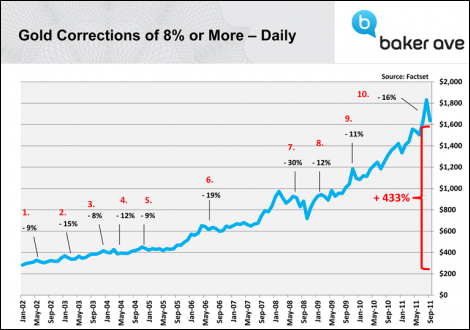 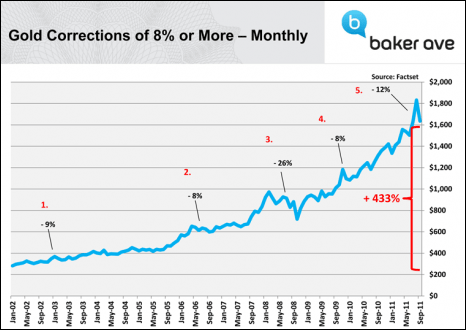 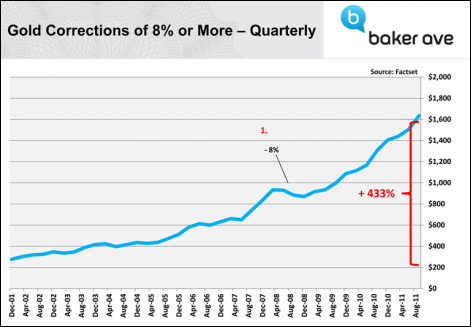 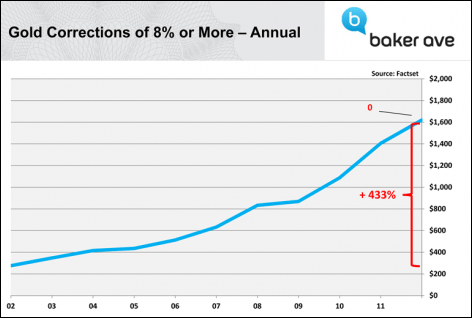 While the gold price has had plenty of big corrections since late 2001, they're not so concerning when viewed beyond a day-to-day basis. In fact, if one resists checking the gold price except once a quarter, one might wonder what all the fuss with price declines is about. You'll also notice that the September decline, when measured monthly, was our second-biggest in the current bull market (and third when calculated daily). This suggests to me that unless we have another 2008-style meltdown in all markets, the low for this correction is in. That's not to say the price couldn't fall from current levels, of course, nor that the market couldn't get more volatile. It's simply a reminder that when viewed on any long-term basis, corrections are nothing but one step down before the next two steps up. It tells us to keep the big picture in mind. It also implies that pullbacks represent buying opportunities. It demonstrates that one could buy any 8% drop with a high degree of confidence. Keep that in mind the next time gold pulls back. Until the fundamental factors driving gold shift dramatically – something that would require most of them to completely reverse direction – I suggest deleting any worries about price fluctuations from your psyche. And if you're still a tad uneasy about today's gold price, well, let's talk next February. Good investing, Jeff Clark, Casey Research |
Sunday, November 13, 2011
Top 10 Tips to Find Your Unclaimed Cash
Find Out the Simple Searches You Can Do to Cash In
By Elisabeth Leamy | Good Morning America – Tue, Nov 8, 2011 5:19 PM ESTThe 50 states and the District of Columbia are currently holding at least $32 billion in unclaimed funds, just waiting to be reunited with the rightful owners.
"Good Morning America" has helped thousands of people find money held for them by the states.
There are simple searches you can do in ten minutes or less. Plus we've uncovered more unusual sources of unclaimed cash that few people know about.
"GMA" is here to help with the top 10 tips you can use today to find your unclaimed cash!
1. Miscellaneous Money
If you are searching for things such as forgotten apartment security deposits, uncashed overtime checks, lost insurance refunds or abandoned safe deposit boxes, your first stop is the states. The National Association of Unclaimed Property Administrators (NAUPA) has set up a free website atwww.unclaimed.org that will link you to the appropriate department in your state that holds the funds. (IMPORTANT: this is a .ORG website, NOT a .com. If you mistakenly type in .com, you will be taken to a pay site. It is never necessary to pay a fee or a finder to help you find unclaimed money.)
2. Missing Money
If you would like to search several states at once, you can do so at another free, though commercially run site called www.missingmoney.com. When you first search, you are prompted to enter your home state. Be sure to search again and this time choose "all states and provinces" on the drop down menu. One last thing: it's not actually ALL states. On the site's home page you can view a map of which states are and are not included. If you have lived in states that do not participate in this site, be sure to go back to Unclaimed.org and search those sites individually.
3. Unclaimed Savings Bonds
It's easy for savings bonds to go unclaimed because they take 30 to 40 years to mature. That's why the Treasury Department has set up a simple search website, available HERE, where you can find forgotten bonds by typing in your social security number. Certain bonds are not listed online and require a hand search. You can read about them at the same Treasury link.
4. Federal Tax Refunds
Everybody looks forward to getting an income tax refund check, but if yours didn't arrive, what do you do? The IRS now provides a "Where's my Refund?" feature on its website. You can look up your missing check by entering the amount you are owed, plus your social security number.
5. Lost Life Insurance Policies
The proceeds of lost life insurance policies may turn up in your state search. If not, and you suspect you are the beneficiary of a loved one's lost life insurance policy, you can hire a company called MIB Solutions to search for you. MIB is a private company that houses life insurance application information for much of the industry. It costs $75 to search. Go to www.policylocator.com for more information.
6. Failed Accounts In a Bank If you didn't collect your money when your bank went under, chances are your account was insured by the Federal Deposit Insurance Corporation (FDIC). The good news, in that case, is that the FDIC is holding your money, and you can find it HERE.
7. Failed Accounts In a Credit Union
If your money was in a credit union as it failed, visit the National Credit Union Administration (NCUA) HERE to track down your money.
8. Misplaced Pensions
If your company still exists, or has been bought out, you need to approach the company directly. If you are owed a pension from a company that went under, there is a federal agency, the Pension Benefit Guaranty Corporation (PBGC), that safeguards private pensions. You can track down your pension HERE on the PBGC website.
9. Retirement Money
The Employee Benefits Security Administration (EBSA), is the federal agency charged with making sure retirement money is reunited with its rightful owners. The EBSA sometimes even sues to seize retirement money. You can utilize the agency's services by clicking HERE.
10. Lost 401(k)s
Sometimes when people leave a job, they leave behind a 401(k) as well. If the company goes out of business, that only compounds the confusion. Fortunately, companies that administer 401(k) plans have teamed up to create a search engine you can use to track down your 401(k).
Money: How to Get It and Keep It
By Doug Casey, Casey Research
Even if you are already wealthy, some thought on this topic is worthwhile. What would you do if some act of God or of government, a catastrophic lawsuit or a really serious misjudgment took you back to Square One? One thing about a real depression is that everybody loses. As Richard Russell has quipped, the winners are those who lose the least. And as far as I’m concerned, the Greater Depression is looming, not just another cyclical downturn. You may find that, although you’re far ahead of your neighbors (you own precious metals, you’ve diversified internationally and you don’t believe much of what you hear from official sources), you’re still not as prepared as you’d like.
I think a good plan would be to approach the problem in four steps: Liquidate, Consolidate, Create and Speculate.
Step 1: Liquidate
Chances are high that you have too much “stuff.” Your garage, basement and attic are so full of possessions that you may be renting a storage unit for the overflow. That stuff is costing you money in storage cost, in depreciation and in the weight of psychological baggage. It’s limiting your options; it’s weighing you down. Get rid of it.
Right now it has a market value. Perhaps to a friend you can call. Or to a neighbor who might buy it if you have a yard sale. Or to some of the millions of people on eBay. A year from now, when we’re out of the eye of the financial hurricane and back into the storm, it will likely have much less value. But right now there’s a market. Even if most people are no longer wearing those “He who dies with the most toys, wins” T-shirts that were popular at the height of the boom, there are still buyers. But the general standard of living is dropping, and mass psychology is changing. In a year or two, you may find there aren’t any bids and the psychology of the country has changed radically. People will be desperate for cash, and they’ll all be cleaning out their storage units (partly because they can’t afford the rent on them).
Liquidate whatever you don’t actually need – clothes, furniture, tools, cars, bikes, collections, electronics, properties, you-name-it. You’ll be able to re-buy something like it, or better, cheaper. Just as important, you’ll feel light and mobile. Unburdened by a bunch of possessions that own you and weigh you down. It will definitely improve your psychology, which is critical to the next stage. And the cash it generates will be helpful for the rest of the plan.
Step 2: Consolidate
Take stock of your assets. After Step 1, that should be a lot easier, because you’ll have less junk but a lot more cash. You’ll already feel more in control and empowered. And definitely richer. But your main assets aren’t money or things. It’s the knowledge, skills and connections you possess. Take stock of them. What do you know? What can you do? Whom do you know? Make lists and think about these things, with an eye to maximizing their value.
If you’re light on knowledge, skills and connections, then do something about it – although if you’re reading this, you probably already live life in a way that builds all of those assets daily. But there’s always room for improvement. Think the Count of Monte Cristo. Or, if you’re not so classically oriented, think Sarah Connor after she met the Terminator.
Part of this process is to look at what you’re now doing. The chances are excellent there’s a better and more profitable allocation of your time. Even successful rock stars tend to reinvent themselves every few years. You don’t want to get stale. That leads to Step 3.
Step 3: Create
Remember, the essence of becoming wealthy is to produce more than you consume and save the difference. But it’s hard to maximize value working for somebody else. And when you’re given a job, it can be taken away for any number of reasons. There is cause and there is effect. You don’t want to be the effect of somebody else’s cause. You want to be the cause for everything in your life. That implies working for yourself. At least turn your present employer into a partner or an associate.
Perhaps go through the Yellow Pages (while they still exist), page by page, line by line, and see what you can provide as a service for the businesses advertising there. I promise you, they’re all looking for someone to come along, kiss their world and make it better. Think like an entrepreneur at all times. Remember that there is an infinite desire for goods and services on the part of the 6 billion other people on the planet. Find out how you can give them what they want, and the money will roll in.
I’ve said many times that I believe you could airdrop me naked and penniless into the heart of the Congo, and by the time I emerged, I’d not just have survived, I’d come out wealthy. And, believe me, I don’t think wealth is by any means the most important thing in life; it’s important but should be considered a convenience, not an imperative. Not that I’d want to be airdropped into the Congo at the moment; I’ve gotten a bit lazy, I have other interests, and you can’t be everywhere and do everything.
But now that I think about it, if I wanted to make a real fortune today from a small base, I might prefer Africa to any other continent. As an educated Westerner, you can quickly meet anyone, on an equal level, much more easily than you could at home. If you have a reason that makes any sense at all, you can be in the office of the president within a week. These countries are all plagued with incompetence and corruption, they need everything, and they’re full of untapped resources and talent. This all inures to the great advantage of a foreign entrepreneur.
Here’s an idea. For your next vacation, book a trip to Cameroon, Togo, Gabon, Zimbabwe or Angola. Go through the Yellow Pages in the capital and meet everybody who is anybody. The chances are good you’ll come up with several deals in the first week alone. If you can’t find the time, send your kid who’s just out of school and idiotically thinks he may want to misallocate time and money getting an MBA. This idea alone should be worth a million dollars. Or, as I would prefer to think of it, 700 ounces of gold.
But to an economist, money, like all goods, has “declining marginal utility.” In other words, the more of something you have, the less you need or want the next unit. Of course more is always better, but it’s unseemly, even degrading, to pursue anything beyond a certain point.
When I was in Toronto a couple months ago, I spoke with a Chinese friend who, I believe, is worth at least $250 million. As he waxed philosophic, he allowed that he didn’t feel he really needed more than 30 extra large to live exactly as he liked. I agreed, in that meals in the best restaurants, the finest clothes, cars and houses only cost so much. And it’s well within a conservative return on that capital, without ever even touching the principal. Is it worth it to get more? Perhaps not, unless your interests in the rest of life are entirely too narrow. The point of money is to allow you freedom, not make you crazy with getting more.
That doesn’t rule out speculation as an avocation, however. More – everything else being equal – is still better.
Step 4: Speculate
You’ve got money. Now you have to keep it and make it grow, because staying in the same place amounts to going backwards. That’s partially because the world at large will continue getting wealthier, even as the dollars you own lose value.
In the past, I’ve discussed why a lot of old rules for success are actually going to prove counterproductive over the next few years. Saving with dollars will be foolish as they dry up and blow away. Investing according to classic rules will be very tricky in a radically changing economy. Most people will try to outrun inflation by trading or gambling. The markets, which are the natural friend of productive people, will perversely prove very destructive to them in the years to come. You’ll know when the final bottom in the stock market has come: The average guy won’t want to hear about the stock market, if he even remembers it exists. And if he does, he’ll want it abolished.
Instead of becoming a victim of inflation and other politically caused distortions in the marketplace, you can profit from these things. Rational speculation is the optimum approach.
What to Do If You’re Already Wealthy?
Perhaps, however, you’ve already covered all the financial bases to your satisfaction. Quo vadis? I have several thoughts on the meaning of wealth. You may find some of them of value as prices of everything fluctuate radically in the years ahead.
First, recognize that wealth is a high moral good. Don’t feel guilty about having it or about wanting more.
If you’ve already accumulated and deployed enough capital to allow you to jump off the golden treadmill, congratulations: chances are high that you are an exceptional human being. I say that because the moral value of being wealthy is underrated. I don’t mean that in a Calvinistic way, in that Calvin believed Yahweh rewarded the righteous by making them rich. But I do believe that productive people – people who work hard to provide goods and services for others – definitely tend to be wealthier than unproductive people. They deserve to be. And since we don’t live in a malevolent universe, people generally get what they deserve. So, yes, wealth is definitely one indicator of moral excellence.
Sure, some wealthy people got that way by lying, cheating and stealing. But they’re exceptions. It’s much easier to become wealthy if (in addition to having virtues like diligence, competence and judgment) you are known to be truthful and honest. Those who automatically think ill of the rich are, at best, paranoid fools. Put it this way: Rich people may lack some virtues, but they definitely have at least a few that made them rich. Poor people, on the other hand, will certainly lack some virtues, and they’ll definitely have some vices that kept them poor.
I’m a fan of some aspects of Gurdjieff, the late 19th to mid 20th century Russian mystic, who was also a merchant adventurer at some points in his colorful life. He said that anyone who successfully employed at least 20 other people must be considered at least partially enlightened and a type of guru. That viewpoint always resonated with me. Self-made wealthy people may not be saints or mystics or intellectuals or even especially thoughtful or moral. But they’ve proven they’re better than the average bear in at least one important way: they can create and conserve wealth. And they’ve thereby eased everyone’s path to further accomplishments.
Second, figure out your purpose in having money.
Sure, money makes life easier. And it’s nice how it enables you to assist people you like with material things. But I strongly suggest that you not take too short a view on this matter. Accelerating advances in medical science are not only lengthening human life expectancy, but new developments now in the works have the potential to vastly improve your capability and health as well.
Is it possible to live to age 200, with all the wealth, knowledge and wisdom that implies, while maintaining the body of a 30-year-old? Not yet. But the prospect is on the horizon. It will, however, be available only to those who can afford it. Ray Kurzweil makes a case that the Singularity is near, and I buy his reasoning. It would be tragic indeed if anyone frittered away his wealth, thinking he wouldn’t live very long, and then succumbed to a self-fulfilling prophecy, not because of medical difficulties, but because of financial difficulties.
Third, don’t give your money to charity.
Entirely apart from showing a lack of both imagination and foresight, it’s a complete waste of good money, pure and simple. Contrary to popular opinion, it rarely does any good; it often does great harm. The whole concept of charitable giving is corrupt and desperately in need of a complete rethinking.
Fourth, if you do care about posterity (who knows, you might be reincarnated…), and on the chance you don’t make it to the Singularity, carefully consider how to dispose of your estate.
For one thing, there’s no reason to automatically leave anything to your children – unless they deserve it. The notion that someone should inherit just because he shares your genes is flawed and thoughtless. The example of Marcus Aurelius leaving the Roman Empire to his worthless son, Commodus, should be instructive. Wealth should be left to someone who is most capable of increasing it – at least if you want to benefit humanity in general. And, yes, I’m quite aware that humanity in general may deserve absolutely nothing.
At a minimum, consider that memes are far more important than genes. It’s wiser, therefore, to leave your wealth only to individuals (related to you or not) who will carry forth values you hold dear and are worthy of the wealth. If nothing else, make sure you disinherit the government.
Also consider that dividing wealth dissipates it and generally makes it less useful. If you have a million dollars, you could leave a thousand dollars to each of a thousand people. But apart from the fact that it’s unlikely anyone knows a thousand worthy people, that much money is only enough for a modest vacation or a few baubles. The larger the pool of capital, the more ways it can be used, the more creative power it has, and the more likely it will be conserved and used creatively. I favor the Roman system, in which one could adopt children of any age – but always after you could see what their character was. You might want to do that if your own kids don’t make the grade.
The Bottom Line
If you want serious money, you have to get serious about money. You need to understand these fundamentals and never forget them. Don’t let all the garbage reported in the financial media you read, see or hear confuse you about what money really is. Don’t consume more than you make: save! Don’t spend: invest!
Tuesday, November 8, 2011
I've Found the Market's Newest Timing Indicator
| By Jeff Clark |
| Tuesday, November 8, 2011 |
Move over Goldman Sachs. There's a new canary in the coal mine.
Ever since Bank of America gobbled up Merrill Lynch (or was forced by the Feds to stomach it), I've been searching for a new leading indicator for the short-term direction of the stock market. For nearly 20 years, I used shares of Merrill Lynch as the proverbial canary in the coal mine.
Merrill was a wonderful market timing indicator. If the market was going to rally, shares of Merrill Lynch rallied first. If stocks were due for a drop, Merrill would signal it ahead of time. I often wrote about Merrill's canary-like attributes (here, here, and here). And I mournedthe day the shares stopped trading in September 2008.
Ever since then, I've been in search of a new canary. At first, the banking index fund (BKX) looked like a good candidate. But I found it moved with the market, rather than ahead of it.
Then I started using Goldman Sachs (GS). That worked OK for a while… But Goldman is not a true canary. It's a blood-sucking vampire squid, as Rolling Stone's Matt Taibbi once famously called it. And its performance as a leading timing indicator has been disappointing.
So I kept searching for a new canary… And I finally found it.
ExxonMobil (XOM) – the oil industry behemoth – is a leading market-timing indicator, and the market's new canary.
I've been following the minute-to-minute action in XOM shares for several months. The action is remarkably similar to the way shares of Merrill Lynch used to trade. If the market is rallying and shares of XOM start to pull back, sure enough, the stock market pulls back moments later. If stocks are falling and XOM begins to bounce, the market bounces, too.
So if you want to profit off the short-term direction in stock prices, pay attention to the action in XOM. It'll give you an early clue as to where things are headed.
I don't know exactly why it works this way. Likewise, I never exactly understood why Merrill worked so well as a leading timing indicator. But you don't have to know why something works to profit off it.
Merrill Lynch was a profitable canary for more than 20 years. I'm looking forward to a long, prosperous relationship with ExxonMobil.
Best regards and good trading,
Jeff Clark
Ever since Bank of America gobbled up Merrill Lynch (or was forced by the Feds to stomach it), I've been searching for a new leading indicator for the short-term direction of the stock market. For nearly 20 years, I used shares of Merrill Lynch as the proverbial canary in the coal mine.
Merrill was a wonderful market timing indicator. If the market was going to rally, shares of Merrill Lynch rallied first. If stocks were due for a drop, Merrill would signal it ahead of time. I often wrote about Merrill's canary-like attributes (here, here, and here). And I mournedthe day the shares stopped trading in September 2008.
Ever since then, I've been in search of a new canary. At first, the banking index fund (BKX) looked like a good candidate. But I found it moved with the market, rather than ahead of it.
Then I started using Goldman Sachs (GS). That worked OK for a while… But Goldman is not a true canary. It's a blood-sucking vampire squid, as Rolling Stone's Matt Taibbi once famously called it. And its performance as a leading timing indicator has been disappointing.
So I kept searching for a new canary… And I finally found it.
ExxonMobil (XOM) – the oil industry behemoth – is a leading market-timing indicator, and the market's new canary.
I've been following the minute-to-minute action in XOM shares for several months. The action is remarkably similar to the way shares of Merrill Lynch used to trade. If the market is rallying and shares of XOM start to pull back, sure enough, the stock market pulls back moments later. If stocks are falling and XOM begins to bounce, the market bounces, too.
So if you want to profit off the short-term direction in stock prices, pay attention to the action in XOM. It'll give you an early clue as to where things are headed.
I don't know exactly why it works this way. Likewise, I never exactly understood why Merrill worked so well as a leading timing indicator. But you don't have to know why something works to profit off it.
Merrill Lynch was a profitable canary for more than 20 years. I'm looking forward to a long, prosperous relationship with ExxonMobil.
Best regards and good trading,
Jeff Clark
Friday, October 14, 2011
How to Act on My Most Urgent Warning
By Brian Hunt, editor in chief, Stansberry & Associates
For much of the past few years, I've been issuing a warning you'll never see in the mainstream press… and most likely never hear it from your broker.
Folks who have heeded my warning have saved a lot of money this year… and should continue to do so.
The warning is that contrary to popular belief, there's little difference in owning stocks or commodities these days.
If you make the popular move of buying a basket of commodities with the belief that you're diversifying your portfolio, you're badly mistaken. You're not diversifying your risk… You're actually "doubling down" on a risky bet. You're betting all will be well with the world and its intertwined economies.
You can see the extraordinary "correlation" between stocks and commodities in the chart below. It plots the performance of the benchmark CRB commodity index (black line) versus the performance of the benchmark S&P 500 index (blue line) over the past year.
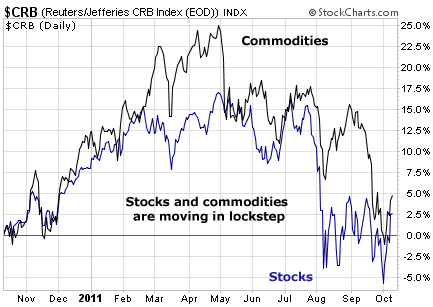
The two indexes move in the same up and down fashion, at the same rate. And they've both plummeted since May:
"Interesting," some readers say. "So what should I do about it?"
When structuring your own portfolio, keep correlation in mind… And consider "lightening up" on stocks and commodities.
You could start by just increasing your cash position. I'm not talking about sitting in U.S. dollars for a decade. But in the short term, cash is your "dry powder." It's money you have on hand to buy bargains when they appear. I often call cash "big returns in waiting."
The next thing you can consider is upping your allocation to gold and silver. Granted, gold and silver aren't the screaming deals they were in 2003, but they still have enormous potential to rise, should the U.S. or European sovereign debt situations blow up.
Finally, consider taking a small portion of your portfolio and putting it into a few "short" positions. Short selling is a strategy that allows you to profit when stocks fall. (I read my colleague Porter Stansberry's advisory for the best short-selling ideas. You can learn why here.)
If you've got most of your money in stocks right now with a commodity "hedge," all you've really got is one giant bet on the same thing. For a safer approach, move money to some or all of the alternatives above.
I can't say exactly what your allocation should be. Everyone has different financial needs and goals. And market conditions change constantly.
But in today's age of massive government spending, borrowing, bailouts, and potential blowups, risk-limiting ideas like these have never been more important.
Regards,
Brian Hunt
For much of the past few years, I've been issuing a warning you'll never see in the mainstream press… and most likely never hear it from your broker.
Folks who have heeded my warning have saved a lot of money this year… and should continue to do so.
The warning is that contrary to popular belief, there's little difference in owning stocks or commodities these days.
If you make the popular move of buying a basket of commodities with the belief that you're diversifying your portfolio, you're badly mistaken. You're not diversifying your risk… You're actually "doubling down" on a risky bet. You're betting all will be well with the world and its intertwined economies.
You can see the extraordinary "correlation" between stocks and commodities in the chart below. It plots the performance of the benchmark CRB commodity index (black line) versus the performance of the benchmark S&P 500 index (blue line) over the past year.
The two indexes move in the same up and down fashion, at the same rate. And they've both plummeted since May:
"Interesting," some readers say. "So what should I do about it?"
When structuring your own portfolio, keep correlation in mind… And consider "lightening up" on stocks and commodities.
You could start by just increasing your cash position. I'm not talking about sitting in U.S. dollars for a decade. But in the short term, cash is your "dry powder." It's money you have on hand to buy bargains when they appear. I often call cash "big returns in waiting."
The next thing you can consider is upping your allocation to gold and silver. Granted, gold and silver aren't the screaming deals they were in 2003, but they still have enormous potential to rise, should the U.S. or European sovereign debt situations blow up.
Finally, consider taking a small portion of your portfolio and putting it into a few "short" positions. Short selling is a strategy that allows you to profit when stocks fall. (I read my colleague Porter Stansberry's advisory for the best short-selling ideas. You can learn why here.)
If you've got most of your money in stocks right now with a commodity "hedge," all you've really got is one giant bet on the same thing. For a safer approach, move money to some or all of the alternatives above.
I can't say exactly what your allocation should be. Everyone has different financial needs and goals. And market conditions change constantly.
But in today's age of massive government spending, borrowing, bailouts, and potential blowups, risk-limiting ideas like these have never been more important.
Regards,
Brian Hunt
Tuesday, October 4, 2011
The Stock Market's All Important Chart!
Brian Hunt's
Market Notes
B
Market Notes
CHART OF THE WEEK: THE STOCK MARKET'S ALL-IMPORTANT BOX
After plummeting 17% in just two weeks, the stock market has formed an extremely important "box." This is the idea behind our chart of the week.
The benchmark S&P 500 stock index spent much of the summer bobbing around the 1,300 level. It reached 1,353 in July. Then the summer crash arrived… and took the index as low as 1,119 (on a closing basis). It has spent the past month flopping up and down in a range between 1,119 and 1,218. Some traders refer to a trading range like this as a "box."
We see the bottom of this box – the 1,119 level – as a "line in the sand" for stocks. If this line is crossed to the downside, it's a major sign the European debt crisis is infecting the rest of the world. It's a major sign the U.S. economy is getting worse.
It's going to be an interesting October…
After plummeting 17% in just two weeks, the stock market has formed an extremely important "box." This is the idea behind our chart of the week.
The benchmark S&P 500 stock index spent much of the summer bobbing around the 1,300 level. It reached 1,353 in July. Then the summer crash arrived… and took the index as low as 1,119 (on a closing basis). It has spent the past month flopping up and down in a range between 1,119 and 1,218. Some traders refer to a trading range like this as a "box."
We see the bottom of this box – the 1,119 level – as a "line in the sand" for stocks. If this line is crossed to the downside, it's a major sign the European debt crisis is infecting the rest of the world. It's a major sign the U.S. economy is getting worse.
It's going to be an interesting October…
B
Tuesday, August 23, 2011
The Next Seven Days Will Determine the Market's Fate
From: The Growth Stock Wire
By Jeff Clark
Tuesday, August 23, 2011
It's too early to give up on the bull market.
Yes, all the major averages are down sharply from their April highs, and much of the damage occurred in just the past month. But you can't call it a bear market yet – at least not until the end of the month.
You see, the difference between a bull market and a bear market is just a thin, blue line.
Take a look at the following monthly chart of the S&P 500, plotted against its 20-month exponential moving average (EMA)…

You've seen this chart before. I use it to define bull and bear markets. It's simple to read. If the S&P 500 is trading above its 20-month EMA (the thin, blue line), we're in a bull market. But if the index trades below the line, the bear is in charge.
According to this chart, we're in bear market.
But… not so fast. The market is never that easy to read. Keep in mind… this is a monthly chart. So all that matters is how the S&P closes at the end of the month. Right now, the chart reads bearish. But if the S&P can somehow miraculously rally and close above 1,213 by the end of August, it will erase the breach of the line and the bull will regain control.
It would be just like the stock market to throw us that sort of curveball…
I know the odds are against it. But this week, I'll put my money on the bull. It's too easy to call this a bear market – and too many people are doing just that. So it's time for a strong, counter-trend rally to muddy the waters a bit.
Take another look at the previous chart and notice the action back in August 2000, when we entered a bear market. You can see the breach of the line and the snapback rally that pushed the S&P up to test the breakdown level. The same thing happened in early 2008, just as that bear market was kicking off.
This is important, because even if the market doesn't rally back to the 20-month EMA right now, it will rally at some point. It's normal for prices to come back and test breakdown levels. So we'll likely see the S&P 500 come back over 1,200 at some point.
I'm betting it happens sooner rather than later.
If it happens by the end of the month, the bull will continue to run. You'll want to use any weakness in September as a chance to buy stocks. But if stocks can't rally between now and the end of the month, the bear is back in charge.
Either way, the next seven trading days will determine the market's fate. Keep a close watch on the markets.
Best regard and good trading,
Jeff Clark
By Jeff Clark
Tuesday, August 23, 2011
It's too early to give up on the bull market.
Yes, all the major averages are down sharply from their April highs, and much of the damage occurred in just the past month. But you can't call it a bear market yet – at least not until the end of the month.
You see, the difference between a bull market and a bear market is just a thin, blue line.
Take a look at the following monthly chart of the S&P 500, plotted against its 20-month exponential moving average (EMA)…
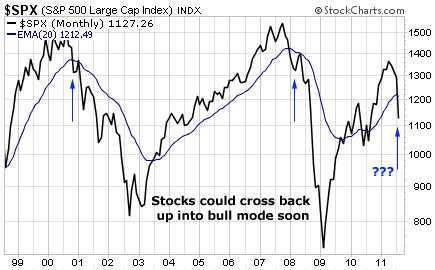
You've seen this chart before. I use it to define bull and bear markets. It's simple to read. If the S&P 500 is trading above its 20-month EMA (the thin, blue line), we're in a bull market. But if the index trades below the line, the bear is in charge.
According to this chart, we're in bear market.
But… not so fast. The market is never that easy to read. Keep in mind… this is a monthly chart. So all that matters is how the S&P closes at the end of the month. Right now, the chart reads bearish. But if the S&P can somehow miraculously rally and close above 1,213 by the end of August, it will erase the breach of the line and the bull will regain control.
It would be just like the stock market to throw us that sort of curveball…
I know the odds are against it. But this week, I'll put my money on the bull. It's too easy to call this a bear market – and too many people are doing just that. So it's time for a strong, counter-trend rally to muddy the waters a bit.
Take another look at the previous chart and notice the action back in August 2000, when we entered a bear market. You can see the breach of the line and the snapback rally that pushed the S&P up to test the breakdown level. The same thing happened in early 2008, just as that bear market was kicking off.
This is important, because even if the market doesn't rally back to the 20-month EMA right now, it will rally at some point. It's normal for prices to come back and test breakdown levels. So we'll likely see the S&P 500 come back over 1,200 at some point.
I'm betting it happens sooner rather than later.
If it happens by the end of the month, the bull will continue to run. You'll want to use any weakness in September as a chance to buy stocks. But if stocks can't rally between now and the end of the month, the bear is back in charge.
Either way, the next seven trading days will determine the market's fate. Keep a close watch on the markets.
Best regard and good trading,
Jeff Clark
Subscribe to:
Posts (Atom)