Showing posts with label stock market. Show all posts

Sunday, November 13, 2011

Money: How to Get It and Keep It

By Doug Casey, Casey Research
Even if you are already wealthy, some thought on this topic is worthwhile. What would you do if some act of God or of government, a catastrophic lawsuit or a really serious misjudgment took you back to Square One? One thing about a real depression is that everybody loses. As Richard Russell has quipped, the winners are those who lose the least. And as far as I’m concerned, the Greater Depression is looming, not just another cyclical downturn. You may find that, although you’re far ahead of your neighbors (you own precious metals, you’ve diversified internationally and you don’t believe much of what you hear from official sources), you’re still not as prepared as you’d like.
I think a good plan would be to approach the problem in four steps: Liquidate, Consolidate, Create and Speculate.

Step 1: Liquidate

Chances are high that you have too much “stuff.” Your garage, basement and attic are so full of possessions that you may be renting a storage unit for the overflow. That stuff is costing you money in storage cost, in depreciation and in the weight of psychological baggage. It’s limiting your options; it’s weighing you down. Get rid of it.
Right now it has a market value. Perhaps to a friend you can call. Or to a neighbor who might buy it if you have a yard sale. Or to some of the millions of people on eBay. A year from now, when we’re out of the eye of the financial hurricane and back into the storm, it will likely have much less value. But right now there’s a market. Even if most people are no longer wearing those “He who dies with the most toys, wins” T-shirts that were popular at the height of the boom, there are still buyers. But the general standard of living is dropping, and mass psychology is changing. In a year or two, you may find there aren’t any bids and the psychology of the country has changed radically. People will be desperate for cash, and they’ll all be cleaning out their storage units (partly because they can’t afford the rent on them).
Liquidate whatever you don’t actually need – clothes, furniture, tools, cars, bikes, collections, electronics, properties, you-name-it. You’ll be able to re-buy something like it, or better, cheaper. Just as important, you’ll feel light and mobile. Unburdened by a bunch of possessions that own you and weigh you down. It will definitely improve your psychology, which is critical to the next stage. And the cash it generates will be helpful for the rest of the plan.

Step 2: Consolidate

Take stock of your assets. After Step 1, that should be a lot easier, because you’ll have less junk but a lot more cash. You’ll already feel more in control and empowered. And definitely richer. But your main assets aren’t money or things. It’s the knowledge, skills and connections you possess. Take stock of them. What do you know? What can you do? Whom do you know? Make lists and think about these things, with an eye to maximizing their value.
If you’re light on knowledge, skills and connections, then do something about it – although if you’re reading this, you probably already live life in a way that builds all of those assets daily. But there’s always room for improvement. Think the Count of Monte Cristo. Or, if you’re not so classically oriented, think Sarah Connor after she met the Terminator.
Part of this process is to look at what you’re now doing. The chances are excellent there’s a better and more profitable allocation of your time. Even successful rock stars tend to reinvent themselves every few years. You don’t want to get stale. That leads to Step 3.

Step 3: Create

Remember, the essence of becoming wealthy is to produce more than you consume and save the difference. But it’s hard to maximize value working for somebody else. And when you’re given a job, it can be taken away for any number of reasons. There is cause and there is effect. You don’t want to be the effect of somebody else’s cause. You want to be the cause for everything in your life. That implies working for yourself. At least turn your present employer into a partner or an associate.
Perhaps go through the Yellow Pages (while they still exist), page by page, line by line, and see what you can provide as a service for the businesses advertising there. I promise you, they’re all looking for someone to come along, kiss their world and make it better. Think like an entrepreneur at all times. Remember that there is an infinite desire for goods and services on the part of the 6 billion other people on the planet. Find out how you can give them what they want, and the money will roll in.
I’ve said many times that I believe you could airdrop me naked and penniless into the heart of the Congo, and by the time I emerged, I’d not just have survived, I’d come out wealthy. And, believe me, I don’t think wealth is by any means the most important thing in life; it’s important but should be considered a convenience, not an imperative. Not that I’d want to be airdropped into the Congo at the moment; I’ve gotten a bit lazy, I have other interests, and you can’t be everywhere and do everything.
But now that I think about it, if I wanted to make a real fortune today from a small base, I might prefer Africa to any other continent. As an educated Westerner, you can quickly meet anyone, on an equal level, much more easily than you could at home. If you have a reason that makes any sense at all, you can be in the office of the president within a week. These countries are all plagued with incompetence and corruption, they need everything, and they’re full of untapped resources and talent. This all inures to the great advantage of a foreign entrepreneur.
Here’s an idea. For your next vacation, book a trip to Cameroon, Togo, Gabon, Zimbabwe or Angola. Go through the Yellow Pages in the capital and meet everybody who is anybody. The chances are good you’ll come up with several deals in the first week alone. If you can’t find the time, send your kid who’s just out of school and idiotically thinks he may want to misallocate time and money getting an MBA. This idea alone should be worth a million dollars. Or, as I would prefer to think of it, 700 ounces of gold.
But to an economist, money, like all goods, has “declining marginal utility.” In other words, the more of something you have, the less you need or want the next unit. Of course more is always better, but it’s unseemly, even degrading, to pursue anything beyond a certain point.
When I was in Toronto a couple months ago, I spoke with a Chinese friend who, I believe, is worth at least $250 million. As he waxed philosophic, he allowed that he didn’t feel he really needed more than 30 extra large to live exactly as he liked. I agreed, in that meals in the best restaurants, the finest clothes, cars and houses only cost so much. And it’s well within a conservative return on that capital, without ever even touching the principal. Is it worth it to get more? Perhaps not, unless your interests in the rest of life are entirely too narrow. The point of money is to allow you freedom, not make you crazy with getting more.
That doesn’t rule out speculation as an avocation, however. More – everything else being equal – is still better.

Step 4: Speculate

You’ve got money. Now you have to keep it and make it grow, because staying in the same place amounts to going backwards. That’s partially because the world at large will continue getting wealthier, even as the dollars you own lose value.
In the past, I’ve discussed why a lot of old rules for success are actually going to prove counterproductive over the next few years. Saving with dollars will be foolish as they dry up and blow away. Investing according to classic rules will be very tricky in a radically changing economy. Most people will try to outrun inflation by trading or gambling. The markets, which are the natural friend of productive people, will perversely prove very destructive to them in the years to come. You’ll know when the final bottom in the stock market has come: The average guy won’t want to hear about the stock market, if he even remembers it exists. And if he does, he’ll want it abolished.
Instead of becoming a victim of inflation and other politically caused distortions in the marketplace, you can profit from these things. Rational speculation is the optimum approach.

What to Do If You’re Already Wealthy?

Perhaps, however, you’ve already covered all the financial bases to your satisfaction. Quo vadis? I have several thoughts on the meaning of wealth. You may find some of them of value as prices of everything fluctuate radically in the years ahead.
First, recognize that wealth is a high moral good. Don’t feel guilty about having it or about wanting more.
If you’ve already accumulated and deployed enough capital to allow you to jump off the golden treadmill, congratulations: chances are high that you are an exceptional human being. I say that because the moral value of being wealthy is underrated. I don’t mean that in a Calvinistic way, in that Calvin believed Yahweh rewarded the righteous by making them rich. But I do believe that productive people – people who work hard to provide goods and services for others – definitely tend to be wealthier than unproductive people. They deserve to be. And since we don’t live in a malevolent universe, people generally get what they deserve. So, yes, wealth is definitely one indicator of moral excellence.
Sure, some wealthy people got that way by lying, cheating and stealing. But they’re exceptions. It’s much easier to become wealthy if (in addition to having virtues like diligence, competence and judgment) you are known to be truthful and honest. Those who automatically think ill of the rich are, at best, paranoid fools. Put it this way: Rich people may lack some virtues, but they definitely have at least a few that made them rich. Poor people, on the other hand, will certainly lack some virtues, and they’ll definitely have some vices that kept them poor.
I’m a fan of some aspects of Gurdjieff, the late 19th  to mid 20th century Russian mystic, who was also a merchant adventurer at some points in his colorful life. He said that anyone who successfully employed at least 20 other people must be considered at least partially enlightened and a type of guru. That viewpoint always resonated with me. Self-made wealthy people may not be saints or mystics or intellectuals or even especially thoughtful or moral. But they’ve proven they’re better than the average bear in at least one important way: they can create and conserve wealth. And they’ve thereby eased everyone’s path to further accomplishments. 
Second, figure out your purpose in having money.
Sure, money makes life easier. And it’s nice how it enables you to assist people you like with material things. But I strongly suggest that you not take too short a view on this matter. Accelerating advances in medical science are not only lengthening human life expectancy, but new developments now in the works have the potential to vastly improve your capability and health as well.
Is it possible to live to age 200, with all the wealth, knowledge and wisdom that implies, while maintaining the body of a 30-year-old? Not yet. But the prospect is on the horizon. It will, however, be available only to those who can afford it. Ray Kurzweil makes a case that the Singularity is near, and I buy his reasoning. It would be tragic indeed if anyone frittered away his wealth, thinking he wouldn’t live very long, and then succumbed to a self-fulfilling prophecy, not because of medical difficulties, but because of financial difficulties.
Third, don’t give your money to charity.
Entirely apart from showing a lack of both imagination and foresight, it’s a complete waste of good money, pure and simple. Contrary to popular opinion, it rarely does any good; it often does great harm. The whole concept of charitable giving is corrupt and desperately in need of a complete rethinking.
Fourth, if you do care about posterity (who knows, you might be reincarnated…), and on the chance you don’t make it to the Singularity, carefully consider how to dispose of your estate.
For one thing, there’s no reason to automatically leave anything to your children – unless they deserve it. The notion that someone should inherit just because he shares your genes is flawed and thoughtless. The example of Marcus Aurelius leaving the Roman Empire to his worthless son, Commodus, should be instructive. Wealth should be left to someone who is most capable of increasing it – at least if you want to benefit humanity in general. And, yes, I’m quite aware that humanity in general may deserve absolutely nothing.
At a minimum, consider that memes are far more important than genes. It’s wiser, therefore, to leave your wealth only to individuals (related to you or not) who will carry forth values you hold dear and are worthy of the wealth. If nothing else, make sure you disinherit the government.
Also consider that dividing wealth dissipates it and generally makes it less useful. If you have a million dollars, you could leave a thousand dollars to each of a thousand people. But apart from the fact that it’s unlikely anyone knows a thousand worthy people, that much money is only enough for a modest vacation or a few baubles. The larger the pool of capital, the more ways it can be used, the more creative power it has, and the more likely it will be conserved and used creatively. I favor the Roman system, in which one could adopt children of any age – but always after you could see what their character was. You might want to do that if your own kids don’t make the grade.

The Bottom Line

If you want serious money, you have to get serious about money. You need to understand these fundamentals and never forget them. Don’t let all the garbage reported in the financial media you read, see or hear confuse you about what money really is. Don’t consume more than you make: save! Don’t spend: invest!

Tuesday, October 4, 2011

The Stock Market's All Important Chart!

Brian Hunt's
Market Notes

CHART OF THE WEEK: THE STOCK MARKET'S ALL-IMPORTANT BOX

After plummeting 17% in just two weeks, the stock market has formed an extremely important "box." This is the idea behind our chart of the week.

The benchmark S&P 500 stock index spent much of the summer bobbing around the 1,300 level. It reached 1,353 in July. Then the summer crash arrived… and took the index as low as 1,119 (on a closing basis). It has spent the past month flopping up and down in a range between 1,119 and 1,218. Some traders refer to a trading range like this as a "box."

We see the bottom of this box – the 1,119 level – as a "line in the sand" for stocks. If this line is crossed to the downside, it's a major sign the European debt crisis is infecting the rest of the world. It's a major sign the U.S. economy is getting worse.

It's going to be an interesting October…


BThe S&P 500 and its all-important box

Tuesday, August 23, 2011

The Next Seven Days Will Determine the Market's Fate

From: The Growth Stock Wire


By Jeff Clark
Tuesday, August 23, 2011
It's too early to give up on the bull market.


Yes, all the major averages are down sharply from their April highs, and much of the damage occurred in just the past month. But you can't call it a bear market yet – at least not until the end of the month.


You see, the difference between a bull market and a bear market is just a thin, blue line.


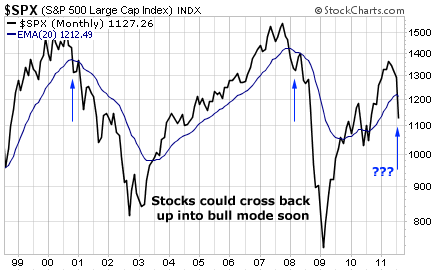
Take a look at the following monthly chart of the S&P 500, plotted against its 20-month exponential moving average (EMA)…


You've seen this chart before. I use it to define bull and bear markets. It's simple to read. If the S&P 500 is trading above its 20-month EMA (the thin, blue line), we're in a bull market. But if the index trades below the line, the bear is in charge.


According to this chart, we're in bear market.


But… not so fast. The market is never that easy to read. Keep in mind… this is a monthly chart. So all that matters is how the S&P closes at the end of the month. Right now, the chart reads bearish. But if the S&P can somehow miraculously rally and close above 1,213 by the end of August, it will erase the breach of the line and the bull will regain control.


It would be just like the stock market to throw us that sort of curveball…


I know the odds are against it. But this week, I'll put my money on the bull. It's too easy to call this a bear market – and too many people are doing just that. So it's time for a strong, counter-trend rally to muddy the waters a bit.


Take another look at the previous chart and notice the action back in August 2000, when we entered a bear market. You can see the breach of the line and the snapback rally that pushed the S&P up to test the breakdown level. The same thing happened in early 2008, just as that bear market was kicking off.


This is important, because even if the market doesn't rally back to the 20-month EMA right now, it will rally at some point. It's normal for prices to come back and test breakdown levels. So we'll likely see the S&P 500 come back over 1,200 at some point.


I'm betting it happens sooner rather than later.


If it happens by the end of the month, the bull will continue to run. You'll want to use any weakness in September as a chance to buy stocks. But if stocks can't rally between now and the end of the month, the bear is back in charge.


Either way, the next seven trading days will determine the market's fate. Keep a close watch on the markets.


Best regard and good trading,


Jeff Clark

Saturday, June 25, 2011

This Simple Stock Market Strategy Would Have Increased Returns 926%

Sage advice worth noting!


By Tom Dyson, publisher, Common Sense Investing
Friday, June 24, 2011
"Dividends don't matter."

I was playing golf with a stock trader last weekend. When I told him I specialize in stocks that pay dividends, he gave me a look of condescension.

"I don't understand what the big deal is with dividends," he explained. "The stock falls by the amount of the dividend, so you can't benefit from it. Total return is the only thing that matters."

On the surface, my golf partner is right. A dividend is simply a cash payout from the company to the shareholder. Whatever the shareholder gains, the company loses. So it seems shareholders don't actually come out ahead.

But as I'll show you today, to say cash payouts like these don't matter is wrong. They improve returns by thousands of percent over the long term.

My friend Meb Faber proved this to me the other day…

Meb is a professional stock market number cruncher, or as he calls himself, a "quant." He's used his skills to create some incredible investing strategies. (You can read more about them here and here.) He alsolaunched an ETF (the symbol is GTAA) so you can follow his system with just one click.

Meb recently crunched the numbers on dividends and other cash payouts and found something amazing.

He started with the Russell 3000, an index of 3000 small-cap stocks. Since 1972, the market-cap weighted Russell 3000 index gained 9.98% a year on average. But when Meb took the highest dividend payers in the index, (the top 10% of dividend payers), he found they returned 13.29% per year… an improvement of more than 3% over the common index.

Meb didn't end his study there…

When most people think of companies returning cash to investors, they think of dividends. But there are two other ways a company returns cash to shareholders.

Stock buybacks are the first way. A company might decide to pay shareholders by buying back its own stock in the open market. To an accountant, it's an identical transaction as a dividend. Cash leaves the company. Cash goes to the shareholders. The difference is, instead of sending each shareholder a check for, say, $100, the company causes the investors' stock to rise in value by $100.

The shareholder has a capital gain instead of a cash income, but the result to the shareholder is the same.

The second way a company returns cash to shareholders without paying dividends is by paying down debt. Cash flows from the company and accrues to shareholders, just like a dividend. In this case, the cash pays off a bondholder who has a senior claim to the stockholder. Once the bondholder is out of the way, the shareholder is that much closer to the future profits.

When you include these two additional ways companies return cash to shareholders, you get the true "cash" yield to shareholders. Meb calls this the "shareholder yield."

Meb repeated his study on the Russell 3000, taking total shareholder yield into account. This is what he found…


Group

Average Annual Return
Russell 3000

9.98%
Dividend Yield (top 10%)

13.29%
Shareholder Yield (top 10%)

16.93%

Earning 9.98% over 38 years turns $1,000 into $37,147. Earning 16.93% a year over 38 years turns $1,000 into $381,229.

In other words, over 38 years, that annual difference of nearly 7% would have increased your total returns by 926%.

The conclusion is, my golf buddy is totally wrong. Stocks that pay out cash generate far higher returns than stocks that don't.

If you're investing for high returns and are ignoring stocks that pay cash out to shareholders, you're missing the point. You should almost always favor companies that pay out cash to investors over those that don't.

Good investing,

Tom

Wednesday, April 27, 2011

This proprietary risk indicator has turned bearish on stocks

From Pragmatic Capitalism:
Our proprietary risk metric is beginning to throw off a warning signal which comes just as the markets are about to enter their seasonally weakest six months of the year.

The risk ratio indicator is a weighted average of bullish to bearish sentiment, the volatility index, the rate of change for the S&P 500, and the new high/new low ratio of the NYSE. This weighted average is then smoothed with an eight week rolling average to eliminate a lot of the noise.

... While a lot of people look at these indicators individually, we combine weight and smooth them to provide a more global look at market psychology and sentiment. Currently, that outlook is very bullish... As a contrarian investment manager, I think this is a time to begin raising cash and hedging risk in portfolios.

The indicator is best used when...

Read full article...

Wednesday, April 6, 2011

One of the top tools for building wealth that practically no one uses

From Financial Mentor:
Isn't it amazing how the choices that determine the bulk of our results are so boringly simple nobody wants to hear about them?
For example, let's say you want to drive from Los Angeles to New York and you're given the choice between two cars: a basic Toyota Camry or a one-of-a-kind, custom race car using the latest, coolest, whiz-bang technology.
Logic says to choose the basic Camry every time. It is the proven, reliable path to achieving the goal. However, the sleek, beautiful race car just reeks of sex appeal and seduces us into the driver's seat for a more-better-different adventure.
Don't get me wrong. I love adventure as much as the next person – probably a lot more. But there is a time and place for everything.
The financial game is about getting results – not having an adventure.
If you want to produce reliable results then use proven technology… even if it is boring...
Read full article...
More on building wealth:
Five easy ways to become wealthier in 2011
Why most investors should ignore stocks with big dividends
Three inexpensive ways to compound your money with dividends
View the original article here

Tuesday, March 15, 2011

Why the majority of investors miss big market moves

From ValueWalk:

The conventional wisdom is that the market is forward-looking. What investors are trying to figure out is, where are stocks headed? They form an assessment of what they think is going to happen to the economy and that determines what prices they are willing to pay for stocks. As their assessments of future economic developments change, stock prices change with them. The stock price that applies on any particular day reflects the collective assessment of millions of investors placing their bets on where the economy is headed.
This is a plausible explanation of why stock prices change. But there is no hard evidence supporting it. It certainly has never been proven. It is a theory, that's all.
My view is that the evidence all points in a different direction...
Read full article...
More on investing:
On a day like today, don't forget your stop losses
Market guru Montier: The seven immutable laws of investing
Top trader Gartman: The investing mistake you must never, ever make
View the original article here

Thursday, March 3, 2011

Six world-class stocks that could pay larger and larger dividends for decades

From Dividend Monk:

When building a dividend-growth portfolio, finding high-quality companies that will continue paying larger and larger dividends for decades rather than just the next few years is important. The longer you can hold onto shares of a company, the lower your trading costs and taxes will be compared to what they would be if you trade often.
But this is only a good strategy if the companies you hold onto continue growing shareholder value.
So the key is to look for companies that, among other things:
a) Have a large and sustainable competitive advantage.
b) Are in an industry that is timeless, or nearly so.
c) Are in a solid financial position.
Here are six sample companies... JNJ, LOW, MCD, WMT, MDT, CVX
Read full article...
More on dividend stocks:
These stocks are an income investor's dream
This list of top stocks for 2011 has something for everyone

Four criteria the world's greatest dividend stocks have in common
View the original article here

Inflation HORROR: "Helicopter Ben" Bernanke says more "quantitative easing" likely

Federal Reserve Chairman Ben S. Bernanke didn't rule out expanding the central bank's asset purchases aimed at stimulating the economy, saying he doesn't want to see the U.S. relapse into a recession.
Asked at a House Financial Services Committee hearing today what conditions would warrant a third round of so-called quantitative easing, Bernanke said that "what we'd like to see is a sustainable recovery. We don't want to see the economy falling back into a double dip or to a stall-out."
Bernanke's testimony today and yesterday signaled that he will keep the Fed on course to complete $600 billion of Treasury purchases through June under the second round of quantitative easing, a policy criticized by Republican lawmakers as risking an inflation surge. He's avoided saying what the central bank may do after that.
A third round of purchases "has to be a decision" of the Federal Open Market Committee, and "it depends again on our mandate" for stable prices and maximum employment, Bernanke said in response to Texas Representative Jeb Hensarling, the House panel's vice chairman and a critic of QE2.
"We're looking very closely at inflation both in terms of too low and too high," Bernanke said during the second day of semiannual testimony on monetary policy. "I want to be sure that you understand that I am very attentive to inflation and potential risks for inflation. That will certainly be a major consideration as we look to determine how to manage this policy."
Beige Book
Separately today, the Fed said in its regional Beige Book survey that the labor market improved throughout the country early this year, driven by increasing retail sales and "solid growth" in manufacturing.
Overall, the economy "continued to expand at a modest to moderate pace," the central bank said in Washington. Eleven of the Fed's 12 regional banks, including San Francisco and Philadelphia, described their regions as expanding, improving or experiencing moderate growth. Only Chicago reported growth "at a pace not quite as strong" as before.
The Standard & Poor's 500 Index rose 0.4% to 1,311.66 at 2:45 p.m. in New York after climbing 0.6% earlier.
Treasuries declined after a report earlier today showed the pace of employment growth is picking up before the Labor Department issues February jobs data March 4. The yield on the 10-year Treasury note rose to 3.46% from 3.39% yesterday.
'Extended Period'
Responding to a question from Representative Nydia Velazquez, a New York Democrat, Bernanke said the Fed's policy of keeping its benchmark rate near zero for an "extended period" helps provide support to the economy, "which in our judgment, it still needs."
"The economy's recovery is not firmly established, and we think monetary policy needs to be supportive," he said.
The second round of bond buying follows a $1.7 trillion first round of purchases of mortgage-backed debt and Treasuries.
Since August, when Bernanke signaled the Fed might buy securities to stimulate the economy, "downside risks to the recovery have receded, and the risk of deflation has become negligible," he said in testimony this week.
Many of the questions Bernanke fielded dealt with the outlook for the federal budget deficit, giving the Fed chief an opportunity to reiterate his call for Congress to come up with a long-term plan for reining in the national debt. Bernanke's statements resonated especially with House Republican lawmakers. The House passed a bill last month cutting $61 billion from 2011 government spending.
Debt, Deficit
"QE2 has given us some opportunity to act on our debt and deficit, and we have not taken advantage of that," panel Chairman Spencer Bachus, an Alabama Republican, said during today's hearing. "Any criticism directed at the chairman, you need to also sort of point that finger back at yourselves."
Bernanke got caught up in a debate over the extent to which House spending cuts would result in job losses. He told lawmakers the reductions may lead to about 200,000 fewer jobs over the next couple of years. That compares with the prediction of Mark Zandi, chief economist at Moody's Analytics, that the budget reductions would mean 700,000 fewer jobs in the U.S. by the end of 2012.
Last week, the Commerce Department reduced its estimate of fourth-quarter growth to a 2.8% annual pace. Consumer purchases rose at a 4.1% pace, the most since the same three months in 2006, compared with a 4.4% rate originally estimated.
Closely Monitor
Inflation is likely to remain low through 2013, Bernanke, 57, a former Princeton University economist, said in Senate testimony yesterday.
"We will continue to monitor these developments closely and are prepared to respond as necessary to best support the ongoing recovery in a context of price stability," he said.
At the same time, the labor market "has improved only slowly," and it may take "several years" for the unemployment rate to reach a "more normal level," he said. "The housing sector remains exceptionally weak," and "slow wage growth" is keeping labor costs in check, he said.
A report yesterday showed U.S. manufacturing accelerated in February to the fastest pace since May 2004. The Tempe, Arizona- based Institute for Supply Management's factory index increased to 61.4 from 60.8 a month earlier. Readings greater than 50 signal growth.
The Fed's preferred price gauge, which excludes food and fuel, rose 0.8% in January from a year earlier, matching December's year-over-year gain, the lowest in five decades of record-keeping. Fed officials aim for long-run overall inflation of 1.6% to 2%.
View the original article here

Wednesday, February 23, 2011

How to find tomorrow's great dividend stocks

From Dividends Value:
... [A] dividend stock analysis is a snapshot in time, but the real question for the savvy dividend investor is ‘where is the stock headed?’
Here are four important directional metrics that I look for when updating my stock database...
1. Declining Shares
Many companies sell stock to raise cash. The important question is what is the company going to do with the cash? Is it for an acquisition or “general corporate purposes?” The latter is code for...
Read full article...

More on dividend stocks:

How to get started in dividend investing
This could be the best dividend opportunity of your lifetime
These dividend stocks could be "the best kept secret on Wall Street"
View the original article here

Wednesday, January 26, 2011

Six big signs the market could plunge soon

From Gold Scents:
Warning signs are starting to build. To start we have a Dow Theory non-confirmation. Usually this is a sign of distribution.

Breadth is diverging. This often happens at intermediate tops.

Emerging markets have failed to make new highs.

China, the driver of global growth appears to be in a bear market.
 
Read full article (with charts)...

More on stocks:
This rare divergence could mean big trouble for stocks
Why this is a great time to buy "insurance" on your stocks
Top market-timer DeMark: A BIG stock market decline is about to begin
View the original article here